
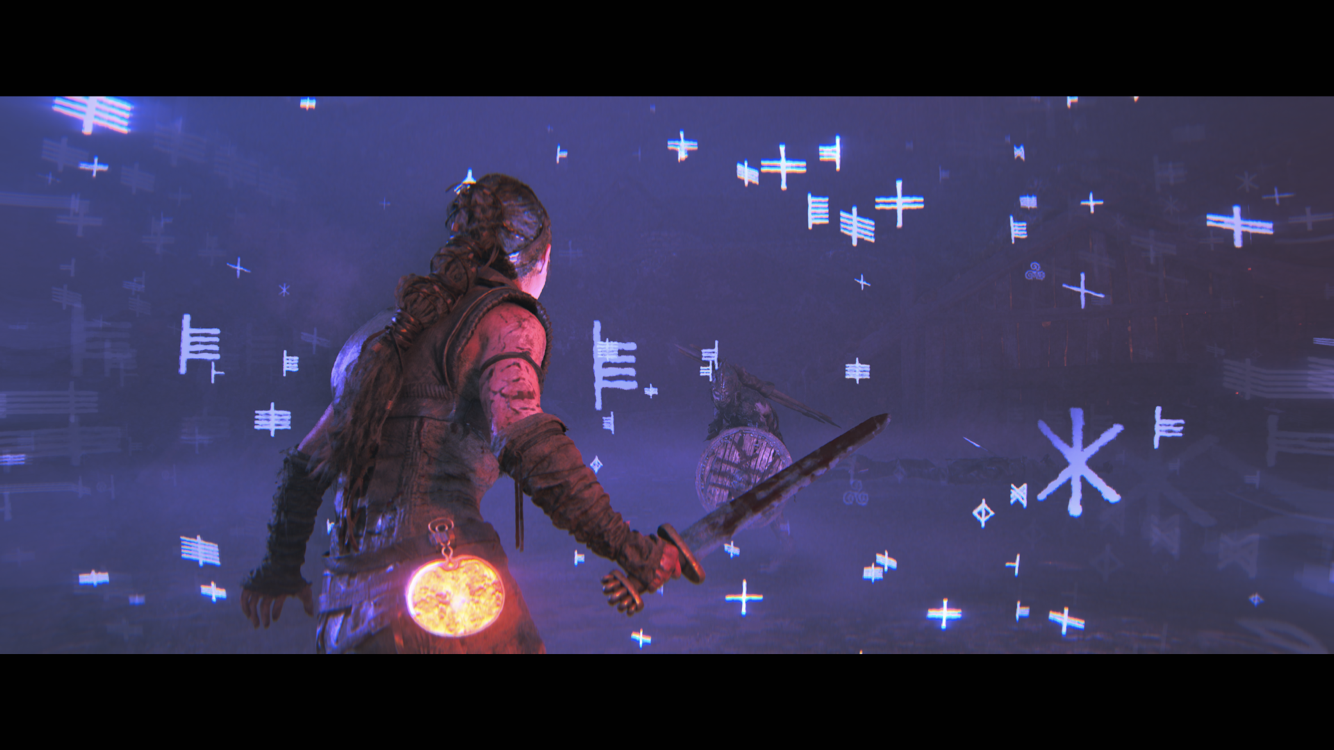
In Hellblade 2: Senua’s Saga the player continues the story of main character Senua who suffers from psychosis, causing hallucinations and voices in her head. The game starts off sometime after the events of Hellblade: Senua's Sacrifice and in contrast to the prequel Senua is not always alone in her new adventure defeating giants in Iceland.
Already from the second chapter Senua is accompanied by the slave master Thórgestr who captured her as a slave initially but gets defeated by Senua after their boat is destroyed in a storm. More characters accompany Senua in later chapters. Therefore, in contrast to Senua's Sacrifice dialogs play a key role in story-telling now. Of course the voices and hallucinations in Senua's head are still there and binaural audio is again used making the player feel the voices come from various directions and create a real immersive experience especially when played with good headphones.
Longer walking scenes for the dialogs change the balance and pacing compared to Hellblade 1. These narrative parts make up for large part of the game now. The puzzles in which you have to search certain symbols in the environment on the other hand were reduced to only a few, contributing positively to a better flow of narrative and gameplay. There are some other types of puzzles now in which you have to activate buttons in a defined order. They follow some standard puzzle design principles and are easy to solve but still give some variety to the game. The action mechanics did not change. You combine light and heavy attacks against enemies and use a parry against small enemy attacks or dodge away from heavy attacks. Also focus mode is back allowing you to kill enemies faster while they only move in slow motion. Disappointingly you now fight enemies one after another and there are never multiple opponents in the same encounter. Switching between enemies based on warnings from the inner voices in Senua's head made the multi-enemy encounter in Senua's Sacrifice more interesting and posed an additional gameplay challenge which the sequel is lacking now. Senua's Saga comes with some more variety in enemy design in terms of visual design and attack patterns but those cannot compensate for this loss of challenge in the gameplay.


Hellblade 2 is surely one of the best audio-visual experiences ever seen in video gaming. Cutscenes and in-game graphics are brilliant with detailed textures and lighting. Character and especially facial animations are stunning and bring video games closer to a truly cinematic experience. The music contributes to the immersion with subdued melodies during calmer parts and driving beats during action sequences. The dialogues are excellently written and recorded and fully lip-synced at all times.
Hellblade 2 continues Senua's journey with a more-of-the-same approach in terms of gameplay with certain improvements in the pacing of storytelling and puzzles. Seven years after Hellblade: Senua's Sacrifice, Senua's Saga, despite being an excellent narrative experience overall, lacks some progress in gameplay, concentrating fully on narrative and audio-visual excellence.